My Silent AI Agents: When Automation Runs My Daily Life
2025
Cycling trip workflow
TL;DR : AI Agents
The Project:Three autonomous AI agents handling bike ride scheduling, morning Notion briefings, and voice-controlled smart home commands.
Stack:n8n, REST API, GPT-4o-mini, OpenAI Whisper, LangChain.
The Challenge:Building a SuperAgent/Sub-agent pattern that routes voice intents to the right service on the fly.
The Result:Three agents in production. Zero manual input day to day.
Three AI agents that work while I do something else. The first tells me when to ride my bike. The second sends me a morning briefing from my Notion tasks. The third runs my home by voice. Everything goes through n8n, Telegram, and zero effort on my end.
01.The Problem
Invisible friction. The kind of micro-tasks that only take thirty seconds each but, strung together, chip away at your focus.
Comparing weather forecasts for the next few days to figure out when to squeeze in a bike ride. Opening Notion first thing in the morning to sort out what's urgent, what's overdue, what can wait. Grabbing your phone with flour-covered hands just to add butter to the grocery list.
My tools, Notion, Todoist, Home Assistant, all worked great. On their own. But they all sat there politely, waiting for me to come check on them. The problem wasn't the tools. It was the lack of a conductor. An assistant that molds itself to my habits. Not the other way around.
02.The Infrastructure: n8n as the Conductor
The engine behind all of this is n8n.
Why n8n over a Python script on a cron job? Because n8n is self-hostable (perfect for my homelab), handles advanced AI concepts natively (memory, tools, LangChain agents), and above all, it gives you a visual interface that makes every workflow readable and easy to maintain.
In practice, I build specialized agents, give them access to specific APIs, and they report back to me on Telegram. Three agents run in production today.
03.The Agent That Plans My Bike Rides
I ride in the Paris region. I try to fit in a late-morning ride once a week. Except the weather around here is a coin flip.
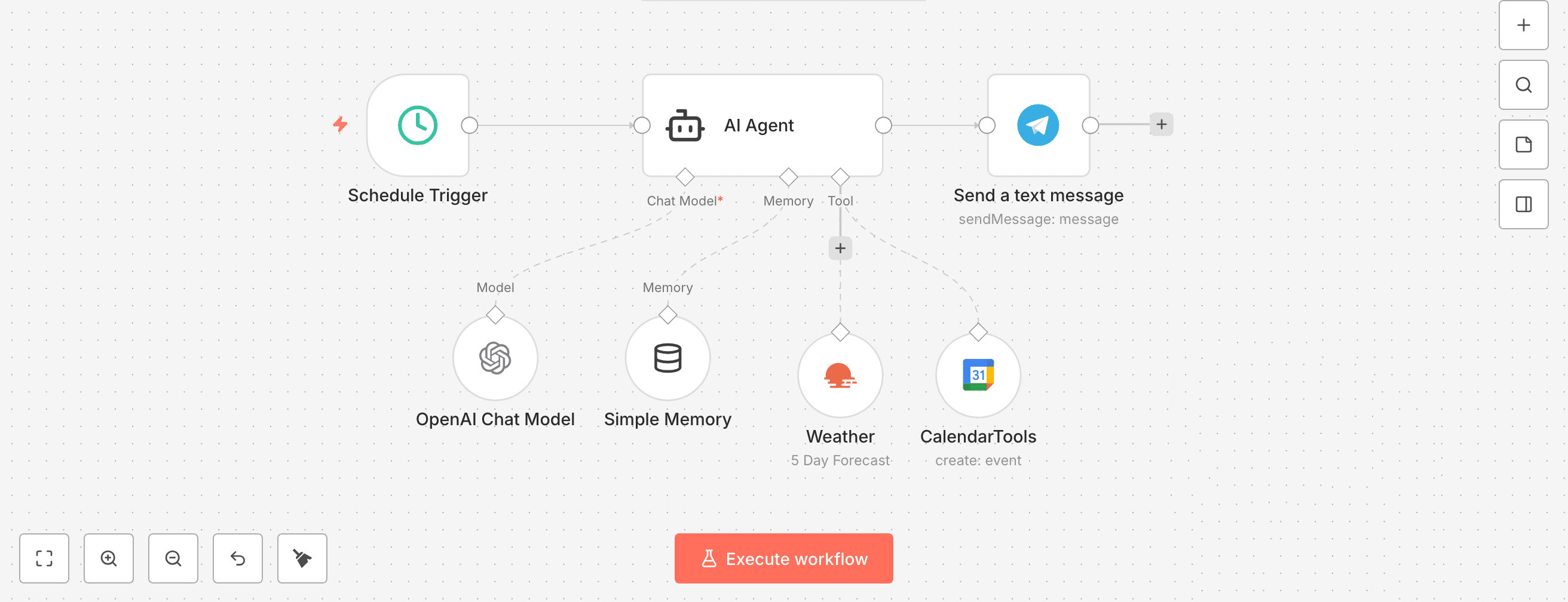
Every Monday at 8:45 AM, a workflow kicks off on its own. The agent grabs 5-day forecasts through the OpenWeatherMap API. Its instructions are narrow: only compare Tuesday and Wednesday, on a tight window from 10:30 AM to noon.
GPT-4o-mini chews through the data and writes me a short report: which day looks better, why. Then sends it to Telegram and blocks the slot in my calendar.
No more spending fifteen minutes staring at rain radars. By Monday morning, I already know when I'm riding.
04.The Agent That Boosts My Productivity (Daily Brief)
My to-do list lives in Notion. But honestly, opening a Kanban board at 7 AM is the fastest way to drown before you've even started.
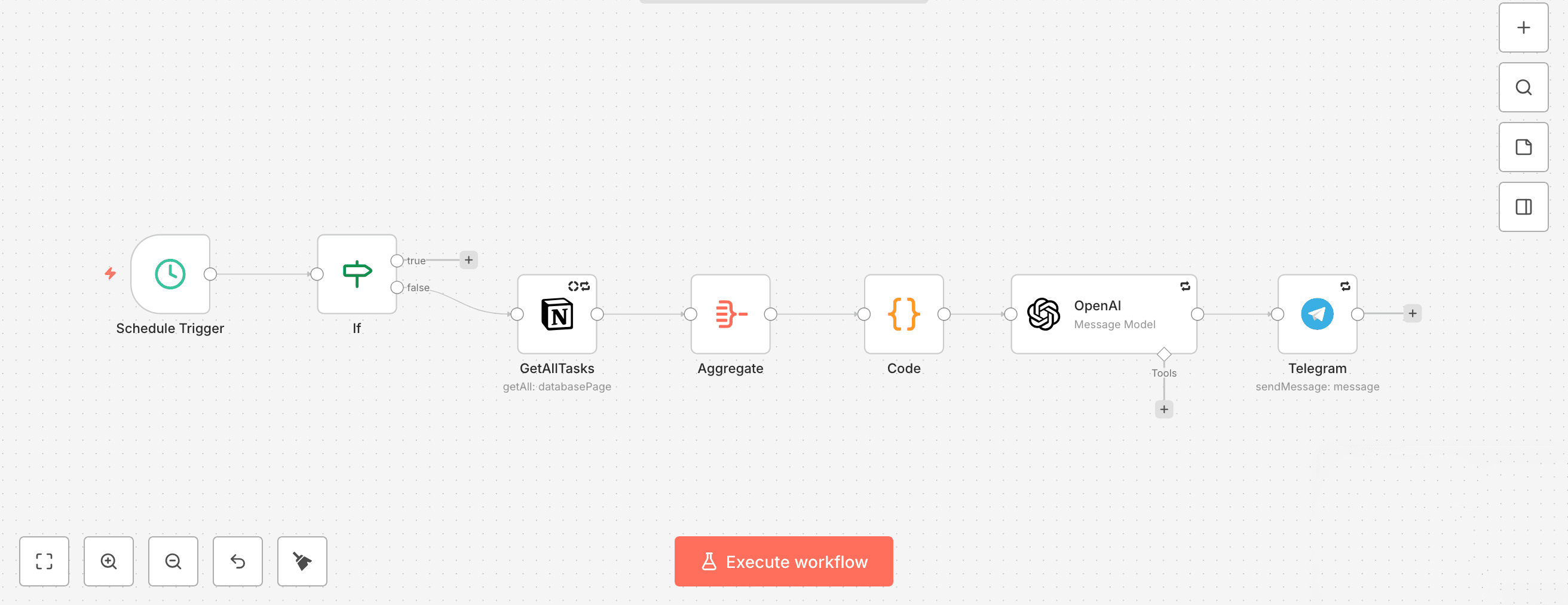
Monday through Friday at 8:50 AM, an agent pings my Notion database. It pulls every unfinished task, the overdue ones and the ones lined up for the day.
Then the AI crunches it all and writes a short briefing: overdue items on one side, today's priorities on the other. With a quick personalized tip to get the day rolling.
What lands on Telegram? A clean, motivating, factual message. Nothing made up. Just what I need to do, laid out nicely.
05.The Home Automation Agent
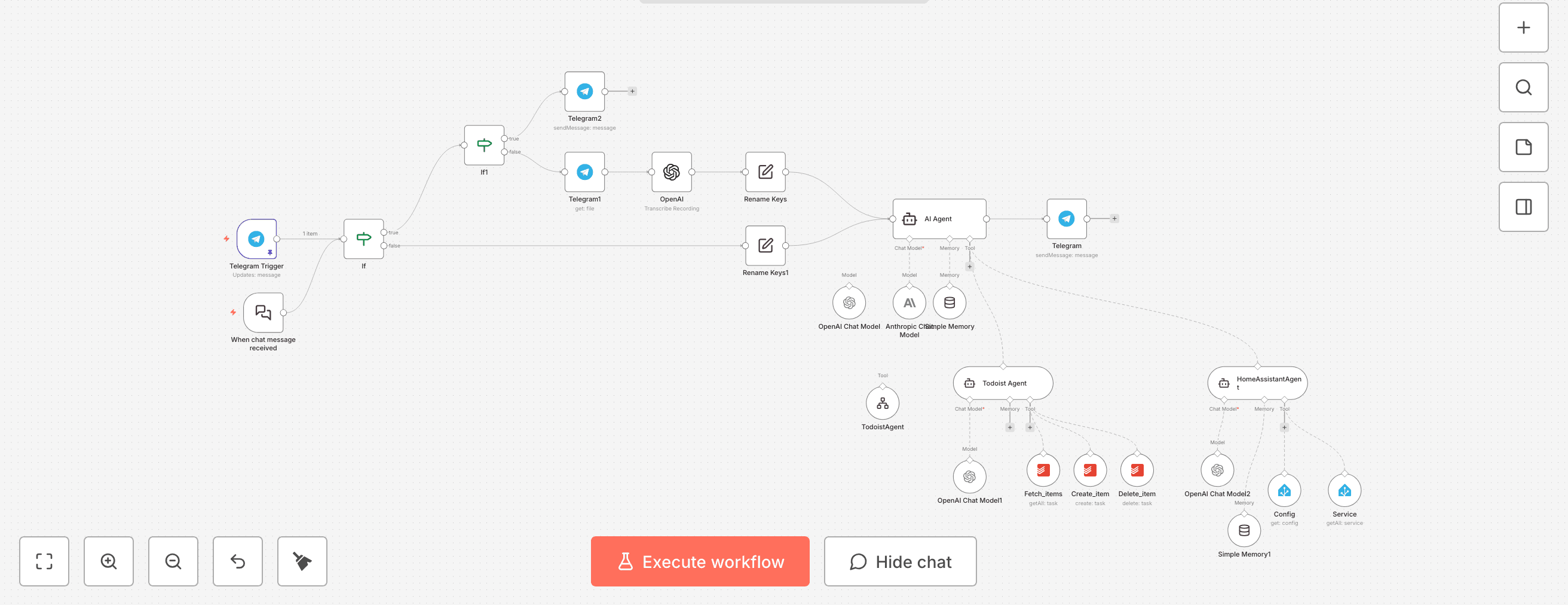
This is the one that's the most fun to build. I set up a "SuperAgent", an orchestrator that handles all interactions with my home.
The interface? Telegram, text or voice. If I send a voice memo, the OpenAI (Whisper) API transcribes it on the fly.
The SuperAgent never does anything itself. It reads the intent behind my request and routes it to the right sub-agent. For instance, a "TodoistAgent" specialized in managing my grocery list: adding, removing, reading.
It's the natural extension of my Anti-Gaspi project. Hooking up its API through a new sub-agent is already in the works. "Add milk to the list." "Remind me to cook the chicken tomorrow." The SuperAgent gets it, handles the dates, and dispatches. One single entry point. Zero friction.
What did these agents teach me? The AI that's actually useful is the AI you forget about. Not another gadget begging for attention. An invisible layer, plugged into your everyday tools, that absorbs the noise and only gives back what counts.
These three agents run on their own, no hand-holding. They let me get my hands dirty with LLM orchestration, the SuperAgent/Sub-agent delegation pattern, and wrangling REST APIs inside async flows. The kind of exploration that feeds directly into how I think about product.